Sustainable Leadership Guidelines

The Sustainable Leadership Guidelines provide innovative and practical advice to managers for transforming thought patterns, behaviours and processes in companies and beyond.

In many regards, our current way of producing, living and working has proven to be unsustainable. We have to change track and pursue a path in alignment to environmental, social and economic imperatives. Actors as diverse as policy-makers, businesses, managers and citizens have to contribute their fair share to attain the Sustainable Development Goals.

Since sustainable development consists of multiple dimensions and requires action at all levels, both political framework conditions and practices in organisations need to evolve. It’s about thinking both aspects together. There is urgency in shifting the current paradigm and reinvent the way we conceive both policies and the purpose of organisations in the light of the pressing environmental, but also social and economic challenges we are currently facing.

In fact, reorienting the purpose of organisations towards environmental and social objectives seems to also pay off economically. For instance, mounting evidence suggests[1] that firms investing in (material) sustainability tend to outperform other companies on traditional measures of performance. Despite that, only few companies have a unified sustainability strategy and even fewer have followed-up with actions, according to a McKinsey survey[2].

Against that background, the three intertwined dimensions of sustainable development [3] offer useful insights to businesses on what to change. They are helpful to understand the different impacts of production and consumption patterns. However, it is crucial to make sense of them at individual level: as a manager, as a worker or as a citizen. Furthermore, the question of “what impact” (on the environment etc.) is closely tied to the procedural “how” of achieving change (company structures and processes). For these reasons, personal and procedural sustainability add to the classical dimensions of economy, society and environment in the Sustainable Leadership Guidelines.

Discover how leadership can contribute to driving the sustainable shift and attain the Sustainable Development Goals in CEC European Managers’ Sustainable Leadership Guidelines (PDF).

[1] https://dash.harvard.edu/bitstream/handle/1/14369106/15-073.pdf?sequence=1

[2] www.mckinsey.com/business-functions/sustainability-and-resource-productivity/our-insights/sustainabilitys-strategic-worthmckinsey-global-survey-results

[3] Environment, society and economy

Launch of the Sustainable Leadership Project

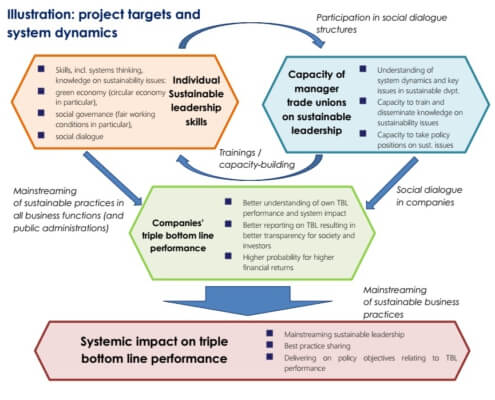
CEC European Managers has started the year 2020 with a European project aiming at piloting a training scheme to mainstream sustainable leadership skills. Only 17% of European managers are trained on sustainability, as our recent report shows. Therefore, CEC will commission a European survey assesses the challenges and opportunities of managers’ specific skills needed for the transition. On the basis of the study results, a training programme will be designed to equip European managers of all backgrounds with the necessary competences in the areas of systemic thinking, Triple Bottom Line accounting, as well as transversal leadership skills such as empathy or mindfulness.

The “Sustainable Leadership for a Fair and Green Transition” project, funded by the European Commission’s DG Employment, will run from January 2020 until the end of 2021. Led by CEC European Managers, it will build on a strong network of national and European organisations, including the project partners Lederne (Denmark), ULA (Germany), MAS (Slovenia), Eurocadres (EU) and CESI (EU). Besides conducting the survey to assess managers’ sustainability skills and providing trainings, the project will also tackle the question of how managerial trade unions and associations can contribute to mainstreaming sustainable leadership through social dialogue. Since social dialogue is demonstrably boosting both economic and social performance of businesses (and avoiding social unrest), it makes sense to incorporate the environmental dimension as a third pillar too.

As challenges change, managers’ role does too

The environmental, economic and social challenges that European managers, professionals and policy-makers currently have to face are characterized by their multi-dimensionality, interconnectedness and urgency (cf. VUCA). Even though these contemporary issues are recognised by senior leaders, as the Global Risks Report 2019 has illustrated, the current paradigm in management education and business practice continues to be centered solely around shareholder value. It is therefore important to develop a European model of sustainable leadership and management. The EU’s commitment to the Sustainable Development Goals, the implementation of the Paris agreement and various other European Commission and social dialogue objectives call to action at operational levels, including in the workplace.

However, only few companies have a unified sustainability strategy and even fewer have followed-up with actions. According to CEC’s “Managers in Europe: today and tomorrow” report, many companies are yet far from reducing their emissions and operational waste significantly. Furthermore, sustainability remains often a departmentalized concern within companies and are only seldom integrated to core business functions such as strategy. In a world of interdependence, where information is key, it is important to develop systemic thinking skills, alongside social and emotional skills needed in people management. Digitalisation will make control-and-command types of management superfluous.

Against that background, the sustainable leadership project aims to provide managers and professionals, some of the key drivers for better social and environmental performance, with the necessary skills to deliver on some of the EU’s main priorities for a sustainable development of the economy. It does so in two ways. First, by identifying generic sustainable leadership skills (procedural dimension). And second, by enhancing managers’, professionals’ and manager trade unions’ capacities in the sustainability dimensions, exemplified within the domains of the circular economy and fair working conditions (chapter II of the European Pillar of Social Rights) as two application domains for sustainable leadership (material dimension).

Please find the work programme of the project here.

Please find the Sustainable Leadership Guidelines by CEC here.

New Platform for Sustainable Leaders

CEC European Managers, together with its project partners, has launched the new SustainableLeaders.eu website in the framework of its Sustainable Leadership Project. At this occasion, the Research Report on Sustainable Leadership in European Management, conducted among 1500 managers in six European countries has been published. The representative findings will help to design a new evidence-based leadership model and a customised training programme to help European managers transition to new standards of management practice, aligned with the EU Green Deal, the SDGs and the Paris Agreement.

Check out the Executive Summary on the state of Sustainable Leadership in Europe

In many ways, the Coronavirus crisis has showcased the vulnerability of our healthcare system, as well as the fragility of our economy. The globalised world economy seems to be currently in reanimation mode, although it is unclear which business models will survive in the long-term. What is clear, in times of crisis, is that value creation and survival have a lot to do with planetary and societal needs, a long-term outlook and adopting a stakeholder approach. As a recognised social partner of the European Commission, CEC  European Managers also highlights the role social dialogue plays in shaping the transition.

The ecological emergency and unprecedented global inequalities leave great opportunities for new kinds of innovation, for collaborative economic ecosystems and for a positive socio-environmental impact, while still realising economic gains. As CEC’s report on the Coronavirus showed, managers are to increasingly consider the role of (digital) people management, professional purpose and mental well-being. Against that background, it will prove important to give managers the right tools to change their modus operandi.

Currently, many tools are being developed to help companies move towards more circular, cooperative and resilient business models. Also globally, the answers on « what » we need to do seem more and more clear : stop incentivising damaging behaviours (like fossil fuel subsidies, tax evasion or labour right abuses) and start incentivising sustainable ones (reforestation, fiscal and social contributions, and decent employment).  However, « how » we will get to a future in line with planetary boundaries and societal needs will require a change in the mind-set and behaviours of the people shaping it.

Today’s economic theory, management schools and business practices often seem stuck in a paradigm that could be described as being short-term, exclusive, linear and not sufficiently human-centred. Against that background, CEC’s Sustainable Leadership project will propose a model for Sustainable Leadership (follow #SustainableLeadership), as well as open source training materials to provide high-quality trainings to European managers, helping them to fit into their new role as change-agents, facilitators and networkers for people, planet and profits.

About the Sustainable Leadership Project

The project is co-funded by the European Union, under a DG Employment grant. From now until mid-2021 CEC and its project partners (Lederne, ULA, MAS and Eurocadres), supported by external advisors New Angles, will develop a model for Sustainable Leadership, gather empirical evidence on Sustainable Leadership practices in European management, organise pilot training workshops for European managers and bring forward the topic through social dialogue and various policy and communication channels.

More information about the Sustainable Leadership Project here.